When buying machined parts, price is only one part of the decision. The quality of the parts can directly affect assembly, production time, product performance, and overall costs. This becomes especially important when a business needs the same part in large quantities or across repeated orders.
A reliable quality control process helps ensure that every batch meets the required drawing, dimensions, material specifications, and finish. This is why businesses should look beyond production capacity when comparing CNC turned parts suppliers. Their inspection methods and ability to maintain consistent quality also deserve attention.
What does quality control mean for CNC turned parts?
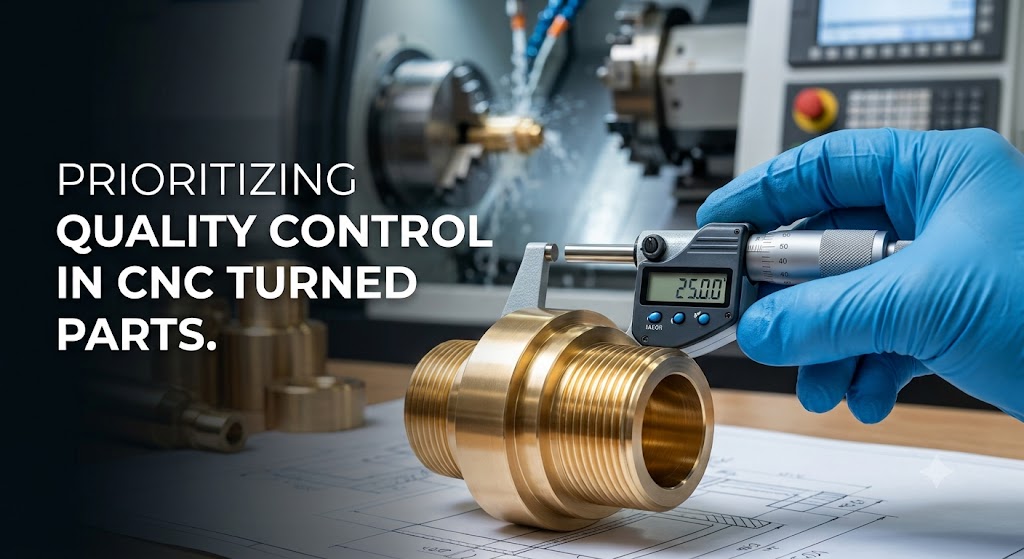
Quality control involves checking whether manufactured parts meet the specifications agreed upon with the buyer. For CNC turned components, this can involve several checks before, during, and after production.
A supplier may check:
- Part dimensions against the approved drawing
- Required tolerances
- Raw material specifications
- Surface finish
- Thread dimensions
- Diameter and length
- Burrs, tool marks, or visible defects
- Consistency across different batches
These checks help identify variations before CNC turning parts reach the customer’s production line. For components that need to fit with other machined or assembled parts, even a small dimensional difference can create problems.
Why quality control should be a key supplier selection factor
- It maintains dimensional accuracy
CNC turning is commonly used when parts need precise dimensions. However, precision depends on more than the CNC machine itself. Tool condition, machine settings, material behaviour, measurement methods, and production controls can all affect the final result.
Quality inspections help confirm that important dimensions remain within the specified tolerance. This is particularly important for CNC turning parts that need to fit into an assembly or work with mating components.
- It keeps production consistent
Getting one acceptable part is not enough when hundreds or thousands are required. The supplier must be able to reproduce the same specifications throughout the production batch.
A good quality control process checks for variations during production. This allows issues to be identified before they affect a large quantity of parts.
For buyers, consistent CNC turned components can mean fewer interruptions during assembly and less time spent sorting or replacing defective parts.
- It reduces rework and rejection
Parts that do not meet specifications may need to be reworked or rejected. In some cases, they may only be discovered after reaching the assembly stage.
This can result in:
- Additional inspection work
- Material wastage
- Re-machining costs
- Delayed assembly
- Replacement orders
- Production downtime
A supplier that carries out suitable inspections can identify many of these problems earlier. This helps reduce avoidable quality-related disruptions.
- It helps meet application requirements
Not every turned part has the same requirements. One application may require a particular material, while another may depend heavily on surface finish, tight tolerances, or specific dimensions.
The supplier needs to understand these requirements before production begins. Quality control then provides a way to verify whether the finished CNC component matches them.
Following customer drawings and specifications is especially important for parts that are used in equipment where fit and dimensional consistency are critical.
- It supports more predictable deliveries
Quality problems can affect delivery schedules. If a batch fails inspection, the supplier may need to produce replacement parts or carry out additional machining.
This can push back the expected delivery date.
Regular inspections during production can help detect deviations earlier. For businesses working with fixed production schedules, this can make supplier quality control an important part of supply planning.
What quality checks should you expect from a CNC parts supplier?
There is no single inspection process that fits every component. The checks should reflect the part design, material, tolerance, quantity, and end use.
Some common checks include:
- Material inspection: The supplier verifies that the raw material matches the required specification. This may include checking material certificates where required.
- Dimensional inspection: Important measurements are checked against the approved engineering drawing.
- Tolerance inspection: Critical dimensions are measured to confirm that they remain within the specified limits.
- Surface finish inspection: The finished surface is checked when the application has specific finish requirements.
- Visual inspection: Operators or inspectors can look for visible issues such as burrs, scratches, cracks, or unusual tool marks.
- In-process inspection: Measurements can be taken during machining instead of waiting until the complete batch is finished. This can help identify process deviations sooner.
- Final inspection: Finished parts are checked before dispatch to confirm that the required specifications have been met.
How to evaluate the quality control process of CNC turned parts suppliers
Choosing a supplier becomes easier when buyers ask specific questions about quality rather than simply asking whether the supplier provides inspection.
- Check the inspection methods
Ask how critical dimensions are measured and which inspection equipment is used. The answer should relate to the requirements of the parts being manufactured.
For example, a component with tight dimensional requirements may need more detailed measurement than a simple turned part.
- Review quality documentation
Depending on the project, buyers may require inspection reports, material certificates, dimensional reports, or other quality records.
Documentation also provides useful information about how the supplier tracks production and inspection results.
- Understand when inspections take place
It is useful to know whether inspection happens only after production or at different stages.
In-process checks can help identify problems before they affect an entire batch. Final inspection then provides another opportunity to verify the completed order.
- Discuss your drawings and tolerances
Before production starts, the supplier should be able to understand the technical requirements of each CNC component provided by the buyer.
Discuss:
- Component drawings
- Critical dimensions
- Tolerance requirements
- Material grades
- Surface finish
- Thread specifications
- Quantity requirements
- Inspection requirements
Clear communication at this stage can prevent misunderstandings later.
Quality control vs. Cost: why the lowest quote may not be the right choice
A lower quote can look attractive at first, but the initial price does not always show the full cost of sourcing a part. If quality issues lead to rejection, rework, or delays, the actual cost can increase.
Cost factor | When quality control is limited | When quality control is properly managed |
Part rejection | More chances of receiving parts outside specifications | Better control over dimensional and quality requirements |
Rework | Additional machining or correction may be required | Fewer avoidable corrections after production |
Material usage | Defective parts can result in material wastage | Better control helps reduce avoidable waste |
Production delays | Replacements or rework can affect schedules | Consistent parts can support smoother production |
Inspection effort | Buyers may need additional checks after delivery | Inspection records can provide greater visibility |
Repeat orders | Quality may vary between batches | Defined checks can help maintain consistency |
The goal is not simply to choose the supplier with the highest or lowest quote. Buyers should compare pricing alongside manufacturing capabilities, inspection processes, tolerances, materials, and expected quality. This is particularly important when evaluating CNC turned parts suppliers for repeat production.
Questions to ask before choosing a CNC parts supplier
Before placing an order, buyers can ask a few practical questions:
- What quality checks are carried out during production?
- How are critical dimensions measured?
- Are final inspection reports available?
- How is the incoming raw material verified?
- How are non-conforming parts handled?
- Can the supplier maintain consistent quality across repeat batches?
- Can the supplier manufacture according to customer drawings and specified tolerances?
- What inspection records can be provided with the order?
The answers can help buyers understand whether the supplier’s process matches the requirements of the project.
Making quality a priority when sourcing CNC turned parts
Quality control is not limited to finding defective parts at the end of production. It is part of the wider process used to maintain dimensional accuracy, material consistency, and repeatable results.
For buyers, the key is to look at how a supplier controls quality throughout production. Clear specifications, suitable inspection methods, in-process checks, and final verification can all contribute to more consistent CNC turned components. Businesses evaluating brass manufacturers should also consider their ability to meet specific material requirements and maintain consistent quality across production batches.
Ganesh Precision manufactures CNC turned parts with attention to dimensional requirements and production consistency. Its CNC machining capabilities can support businesses looking for components made according to specific technical requirements.
To discuss your CNC turned component requirements, contact Ganesh Precision today.