
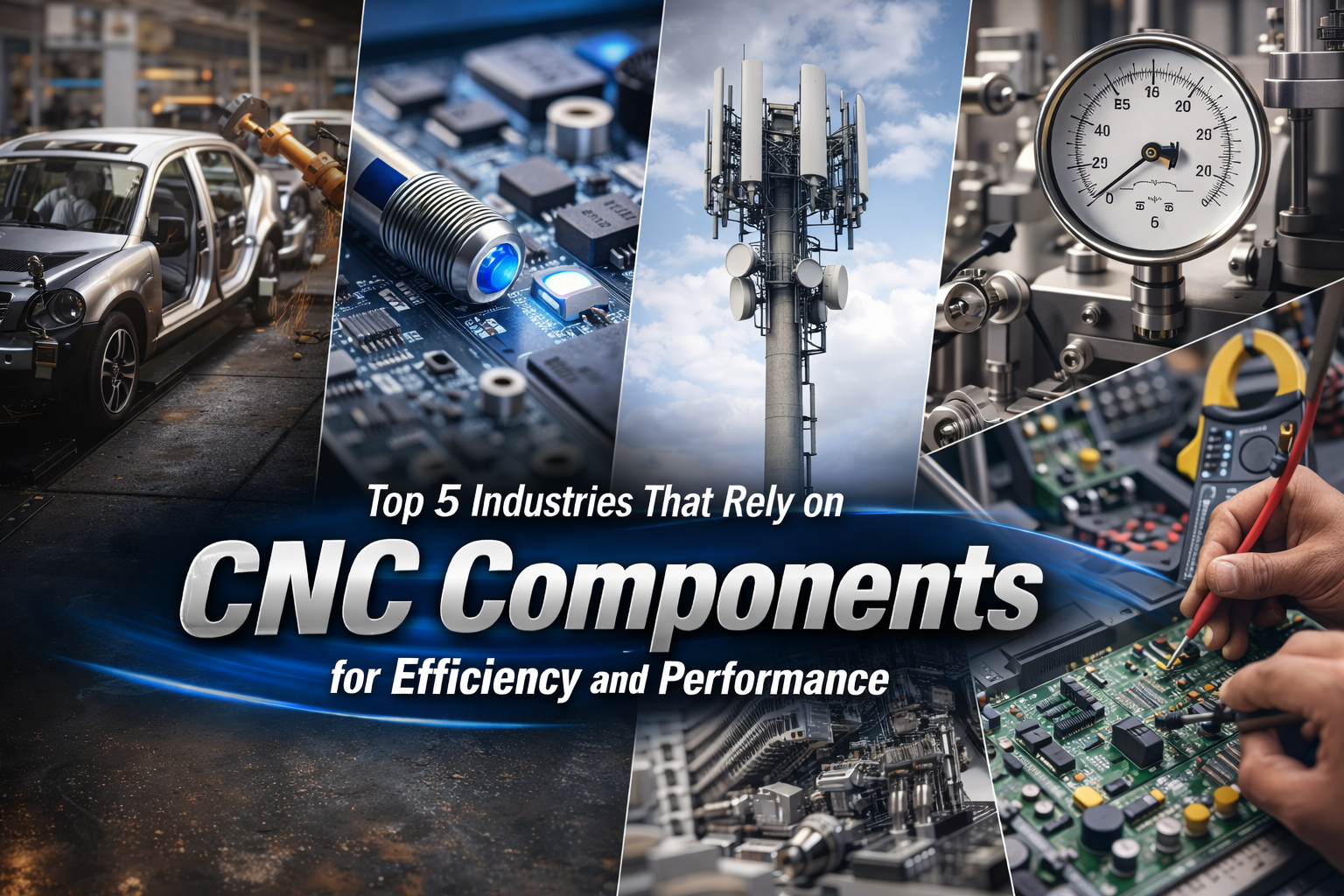
Behind every high-performing machine lies a network of finely engineered parts. Explore how different industries rely on CNC precision parts to achieve accuracy, durability, and operational excellence.
Efficiency and accuracy go hand in hand in today’s manufacturing world. Across sectors, machines demand components that are built with tight tolerances and consistent quality. This is where CNC components make all the difference. They empower manufacturers to produce parts that match exactly the design, deliver long service life, and perform reliably across varied environments and duty cycles.
CNC machining isn’t just about cutting metal. It’s about repeatability, surface finish, tight tolerances, and scalability—from prototypes to mass production. Let’s explore the five major industries where CNC machining services power quality, reliability, and speed.
1. Automobile Industry
The automobile sector is one of the largest consumers of CNC precision parts. Vehicles contain thousands of components operating under heat, vibration, dust, and pressure. Engine parts, shafts, brake system components, bushings, fuel and fluid connectors, and gear elements must meet exact specifications for safety and efficiency.
With CNC machining services, manufacturers achieve uniformity in dimensions and finish, which keeps assembly lines smooth and reduces rework. It also shortens the loop between design and production, enabling faster prototyping for new models and variants. Whether it’s a complex aluminum housing or a hardened steel pin, CNC precision supports quieter drivetrains, better fuel efficiency, and long-term durability—key advantages in a highly competitive market.
2. Sensor Industry
Sensors are now embedded in everything from vehicles and home appliances to medical and industrial equipment. Their performance depends on components that are dimensionally precise and burr-free, because even minor deviations can distort readings. Many sensor housings, diaphragms, fittings, and miniature shafts rely on CNC processes that hold tight tolerances and deliver excellent surface finishes.
CNC machining ensures smooth interfaces, leak-tight fits, and geometries that maintain stability over temperature and time. Importantly, it supports micro-scale parts without sacrificing consistency at volume, which helps sensor manufacturers scale production while maintaining calibration integrity. The result is dependable sensing of pressure, temperature, flow, or motion in demanding real-world conditions.
3. Telecommunication Industry
Telecom networks depend on hardware that must run around the clock with minimal failures. Towers, base stations, and network devices include connectors, housings, heatsink bases, and precision fittings made using industrial CNC components. These parts must meet strict mechanical and electrical criteria to minimize signal loss, manage heat, and withstand outdoor exposure.
CNC machining delivers accurate, durable, and corrosion-resistant parts—from RF connector bodies and threaded adaptors to mounting brackets and enclosure components. As infrastructure evolves toward higher data rates and denser networks, precision and repeatability become even more critical. CNC-made parts help maintain stable connectivity, reduce field failures, and support faster network rollouts.
4. Instrumentation Industry
Instrumentation covers pressure gauges, flow meters, analytical devices, and measurement tools where accuracy is non-negotiable. Readings from these instruments support calibration, testing, and safety checks, so their internal and external components must fit together perfectly and maintain alignment under load.
CNC machining services produce leak-proof fittings, precision bores, and matched surfaces that keep instruments consistent over long operating cycles. The ability to work with brass, stainless steel, aluminum, and engineering plastics gives manufacturers the flexibility to match media compatibility, weight, and cost targets. For users, that translates to stable readings, reduced drift, and easier maintenance across laboratory and industrial environments.
5. Electrical and Electronics Industry
Electrical and electronics applications rely on both small and complex parts that must combine high conductivity with sharp dimensional control. Connectors, terminals, pins, heat-dissipating components, standoffs, and fasteners are common CNC-produced parts. These components need to perform safely across varying voltages, temperatures, and installation conditions.
CNC machining enables accurate shaping, deburring, and finishing that improve mating, conductivity, and thermal performance. It also supports conductive materials such as copper, brass, and aluminum, alongside post-processes like plating or anodizing to enhance corrosion resistance. The outcome is better product reliability, stable electrical characteristics, and longer lifecycle performance in consumer electronics, power systems, and industrial controls.
Why CNC Machining Matters Across Industries
Across these five sectors, CNC machining has become a foundation for progress. It helps manufacturers produce parts faster and more efficiently, reduce waste, and improve quality. The true value lies in consistency: once a process is dialed in, CNC systems replicate parts with minimal variance, enabling smooth assembly, fewer failures, and more predictable maintenance.
Whether it’s a car’s precision shaft, a telecom RF connector, a miniature sensor housing, or a pressure gauge fitting, every CNC component contributes to the performance, safety, and reliability of the final product. As products become smaller, smarter, and more connected, the demand for precision only grows.
Precision That Drives Performance
From automobiles to electronics, industrial CNC components are now essential to modern manufacturing. Their ability to deliver accuracy, durability, and repeatable results has raised the quality bar across every sector, while enabling faster design cycles and better use of materials.
As a trusted CNC parts manufacturer,Ganesh Precision Industries supports these industries with high-quality CNC components and precision parts that align with global expectations and customer specifications. With years of expertise, a commitment to reliability, and a focus on collaborative engineering, the company remains a strong partner for businesses that value precision and performance at scale—making it a standout choice among precision turned parts manufacturers.
Partner with Ganesh Precision Industries for high-quality CNC precision parts that meet your industry’s toughest demands.
Contact us for your CNC needs today!